
On December 4, 2025, the state of New Jersey will host a virtual discussion led by the New Jersey Governor’s Council on Mental Health Stigma, focused on improving mental health services for individuals with co-occurring mental health conditions and intellectual or developmental disabilities.
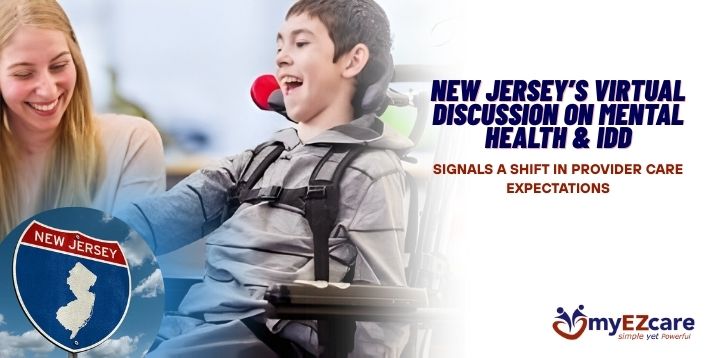
The session is designed specifically for direct service providers, frontline staff, and supervisors, making it one of the most provider-relevant mental health discussions New Jersey has hosted this year.
This is not just another awareness event. It signals a structural shift in how the state is encouraging providers to think about dual-diagnosis care, behavioral health integration, and system coordination going into 2026.
Why This December 4 Discussion Matters for New Jersey Providers
Across New Jersey, more individuals receiving developmental disability services are also living with complex mental health conditions. This dual-diagnosis population requires more than traditional care models. It requires coordination between behavioral health services, home-based care, day programs, and family communication.
This virtual discussion is positioned to address exactly that challenge.
By targeting frontline teams and supervisors, New Jersey is signaling that co-occurring mental health and IDD care is no longer just a clinical specialty area. It is becoming a standard operational expectation for providers across settings.
What Co-Occurring Mental Health & IDD Care Changes for Agencies
When individuals live with both intellectual disabilities and mental health disorders, service gaps become more visible. Missed visits, fragmented communication, inconsistent documentation, and delayed care coordination quickly lead to escalation.
For agencies, this means:
- Care teams must operate with stronger communication
- Documentation must be clearer and more traceable
- Visit consistency becomes more critical
- Supervisory oversight becomes more complex
New Jersey’s December 4 discussion is being held at precisely the time when providers across the country are realizing that fragmented systems cannot sustain modern behavioral health and IDD integration.
How Technology Becomes Part of Mental Health & IDD Stability
Care for individuals with co-occurring conditions depends on timing, accuracy, and early intervention. When systems fail, the impact reaches families first.
Providers using structured home care solutions are better positioned to manage this complexity because documentation, visit verification, scheduling, and supervision operate inside a connected workflow.
When frontline staff, supervisors, and care coordinators are reading from the same system, escalation slows and continuity improves. This reduces pressure on staff while increasing safety for individuals receiving services.
Why New Jersey Is Focusing on Frontline Staff Now
The fact that this discussion is aimed directly at frontline caregivers and supervisors is significant. It reflects a growing understanding that policies alone cannot fix mental health and IDD care gaps. The quality of outcomes depends on:
- How caregivers document behavior changes
- How supervisors monitor service delivery
- How teams coordinate across mental health and developmental support
This December 4 session acknowledges that providers are being asked to work in more complex, emotionally demanding environments than ever before. Supporting them with better systems is now as important as supporting them with training.
A Glimpse Into New Jersey’s 2026 Care Direction
New Jersey is not framing this discussion as a one-time event. It is clearly linked to broader conversations about:
- Reducing stigma across care environments
- Improving coordination between systems
- Supporting staff under increasing behavioral demand
- Protecting individuals with layered care needs
This aligns with what providers are already experiencing. Mental health is no longer secondary inside IDD services. It is now structurally part of everyday care delivery.
What Providers Can Learn from This Without Attending
Even for agencies that do not attend the December 4 virtual session, the takeaway is still clear.
New Jersey is preparing providers for a care environment where:
- Mental health observation becomes routine
- Documentation quality becomes more scrutinized
- Service continuity becomes more critical
- Supervisory visibility becomes essential
Agencies that operate with disconnected systems will feel increasing stress under this model. Those with integrated scheduling, documentation, EVV, and supervision tools will operate with greater stability.
How myEZcare Quietly Supports This Shift
Many New Jersey providers are already adjusting internally to these expectations. They are focusing less on reactive correction and more on proactive visibility.
myEZcare supports these agencies quietly by connecting visit data, behavior notes, staff schedules, and supervisory oversight in one system. This allows providers to identify care gaps early rather than after an escalation occurs.
In co-occurring mental health and IDD environments, prevention is no longer optional. It is the foundation of operational safety.
Where This Leaves New Jersey Providers Right Now
The December 4, 2025 virtual discussion is not about raising awareness alone. It is about preparing the workforce for a new level of care complexity that will define 2026 and beyond.
Providers who treat this as a directional signal rather than a simple webinar will be the ones who experience:
- Lower service disruption
- Better staff coordination
- Stronger family trust
- More stable compliance performance
Those who ignore the structural message may find themselves struggling as expectations tighten around mental health and IDD integration.