
Healthcare organizations rely on software that not only protects patient information but also strengthens the skills and compliance awareness of their staff. As agencies expand their digital operations, integrated staff training modules have become essential. These modules help caregivers, nurses, and administrative teams stay updated on HIPAA regulations, documentation standards, and new workflow practices. Since HIPAA requires ongoing staff education, choosing software that supports training directly inside the platform can simplify compliance and reduce operational stress.
Different software vendors offer training in different ways. Some include built-in learning centers, others provide guided onboarding, and a few connect training directly to documentation or workflow tasks. This comparison explores the leading HIPAA-compliant systems that include integrated training tools and helps providers understand which platforms may fit their operational needs best.
Why Staff Training Matters in HIPAA-Compliant Healthcare Software
HIPAA requires healthcare staff to understand how to handle protected health information, how to document care safely, and how to avoid risky communication practices. While many organizations rely on external training courses, integrated training inside the software brings education closer to real workflows. Caregivers can learn how to document correctly, administrators can understand reporting requirements, and team members can refresh their knowledge without leaving the system.
Integrated training also reduces onboarding time. New staff can learn features through guided steps and structured lessons rather than relying solely on manuals or in-person instructions. This improves accuracy, reduces errors, and supports consistent compliance across the agency.
Agencies that want to learn more about secure operational workflows can refer to resources available through HealthCare Solutions, which help teams understand how HIPAA-aligned documentation and communication support high-quality care delivery.
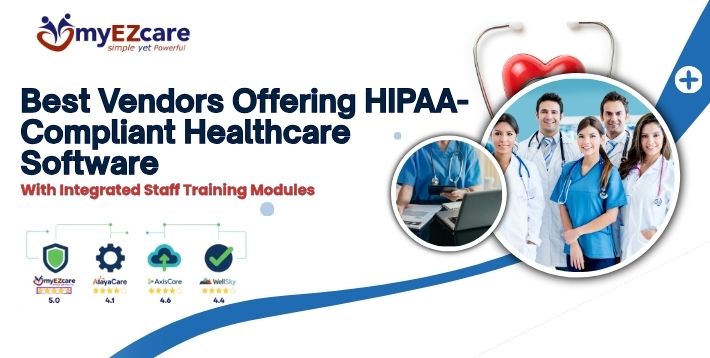
How Leading HIPAA-Compliant Vendors Compare on Training Module Integration
Below is a clear, human-readable comparison of the major HIPAA-compliant software systems that support integrated staff training. Each vendor approaches training differently depending on the type of care they support.
myezcare
myezcare includes integrated training tools that guide caregivers and administrators through EVV workflows, documentation requirements, communication guidelines, and HIPAA-aligned best practices. Training is positioned close to real tasks, allowing staff to learn while using the system. This reduces onboarding challenges and ensures that caregivers understand how to complete visits, record notes, and manage sensitive information within a secure environment.
AxisCare
AxisCare provides training resources focused mainly on operational tasks such as scheduling, visit management, and shift coordination. New caregivers can learn how to clock in, document visits, and follow administrative workflows. Although it offers helpful onboarding, its training features are more practical than compliance-driven.
Axxess
Axxess supports structured training for clinical teams, including nurses and therapists. Its training modules guide staff through clinical documentation, assessments, skilled visit requirements, and electronic charting. Because Axxess supports higher-acuity care settings, its training tools focus heavily on clinical accuracy and regulatory expectations.
WellSky Personal Care
WellSky Personal Care provides training resources for large organizations with multiple branches. Staff can learn process standards, documentation expectations, and system navigation at scale. Training tends to be more administrative and operational, supporting supervisors and multi-location workflows.
CareSmartz360
CareSmartz360 offers training features that guide new staff through scheduling, client records, basic documentation, and system usage. The training modules are accessible and simple, designed for growing agencies that want consistent onboarding without complexity.
AlayaCare
AlayaCare includes training programs for large organizations that rely on advanced dashboards, analytics, and enterprise tools. Training focuses on helping caregivers and administrators navigate complex workflows and maintain consistency across large teams.
Which Vendor Provides the Best Overall Training Experience?
The right vendor depends on the type of organization and the training depth required. Skilled agencies benefit from clinical-focused guidance. Large networks need centralized onboarding across locations. Growing agencies often prefer training that is simple, guided, and easy to follow.
For home care, home health, adult day programs, and community-based providers, myEZcare offers one of the most balanced training experiences because it integrates learning directly into day-to-day workflows. This helps reduce onboarding time while improving compliance accuracy.
Conclusion
HIPAA-compliant healthcare software with integrated staff training modules helps organizations maintain security, reduce errors, and support ongoing compliance. myEZcare stands out for workflow-connected training designed for community-based care, while AxisCare, Axxess, WellSky Personal Care, AlayaCare, and CareSmartz360 each offer valuable approaches tailored to their respective service models.
The ideal solution is the one that strengthens your team’s confidence, supports your workflows, and ensures consistent, compliant operations across your organization.
FAQs
1. Why do healthcare organizations need software with integrated staff training modules?
Integrated training helps staff learn documentation standards, HIPAA compliance rules, and workflow expectations directly inside the system, reducing errors and improving readiness.
2. Which HIPAA-compliant platform offers the best built-in staff training features?
myezcare provides strong, workflow-integrated training tools ideal for home care, home health, and adult day programs that need real-world guidance tied to daily tasks.
3. Can staff training improve HIPAA compliance?
Yes. Training helps staff understand secure data handling, documentation accuracy, and communication rules, all of which reduce compliance violations.
4. Do all healthcare software vendors include staff training modules?
No. Some offer basic onboarding, while others provide structured lessons, workflow guidance, or clinical documentation training. Vendors differ widely in depth.
5. Are built-in training modules useful for small healthcare agencies?
They are especially useful for small agencies because they simplify onboarding, reduce administrative workload, and help new staff adapt to secure workflows quickly.